
Why You Can’t Make an Estate Plan at the Bank
A client came to me last year. We were trying to untangle how and when ownership on a bank account had been changed by a recently deceased relative.
I reached out to the credit union and asked for a copy of their account agreement.
My jaw dropped when I read a paragraph that basically said that
Any one joint owner can:
– withdraw all the funds,
– close the account,
– change the ownership, and
– even change beneficiaries or account type…
without the other joint owners’ consent or knowledge.
Don’t believe me? Here it is from Listerhill Credit Union’s Membership and Account Agreement:

Listerhill Membership and Account Agreement, Section 3(b).
and:
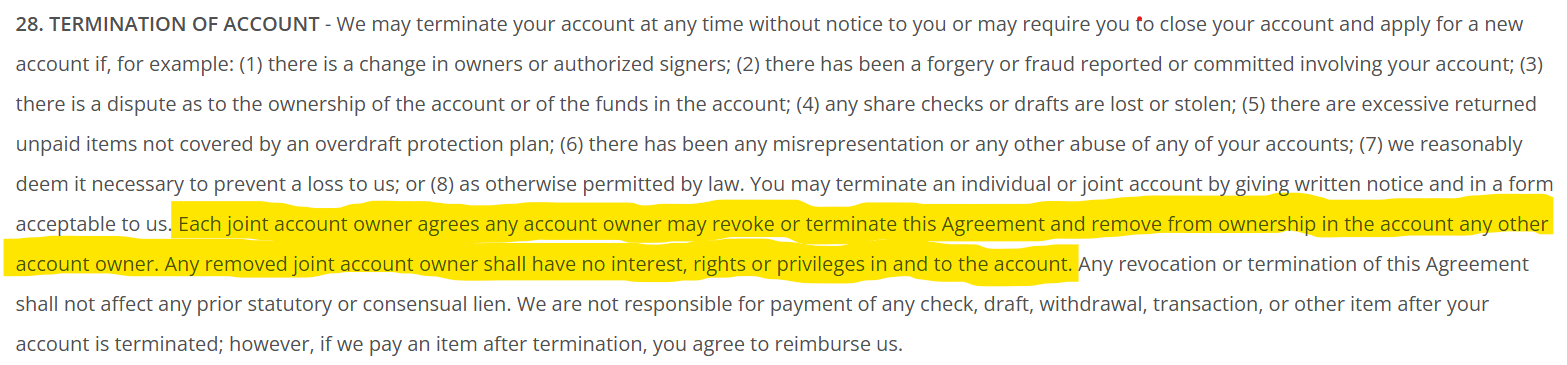
Listerhill Membership and Account Agreement, Section 28.
I’ve been warning people for years about the dangers of joint accounts. But this? This — seeing this provision in black-and-white — was a new level.
And it perfectly illustrates why you cannot make an estate plan at your bank.
The Old Horrors of Joint Accounts (Greatest Hits)
Before we get to the “change the owners” horror, let’s recap the old villains. When a bank employee says:
“Oh, you want your daughter to be able to help you and get what’s left when you die? Just add her to your account!”
…they’re casually handing you a grenade to blow up your estate plan.
Here’s what I mean.
1. You might accidentally disinherit someone
Suppose you have three kids: Alice, Ben, and Carla.
You walk into the bank and say, “I want all three to get what’s left when I die, but Alice helps me with my bills, so put her on the account.”
The bank does what the bank always does: they make it a joint account with you and Alice.
Result at your death?
The account doesn’t follow your will.
The account doesn’t follow your “1/3 - 1/3 - 1/3” intent.
The entire balance goes to Alice, by right of survivorship, even if your will says “everything in equal shares to my children.”
Alice may be as honest as the day is long and intend to share. But legally, the money is hers. If she gets divorced, sued, or dies unexpectedly, that money can be gone before Ben and Carla ever see a dime. And you might be surprised how many people in Alice’s shoes lose their sense of duty and generosity when they’re told they are legally entitled to 100% of the funds.
2. You expose the account to your child’s creditors
When you add a child as a joint owner, you’re not just giving them “access.”
You’re giving their creditors access too.
Car wreck judgment.
Bankruptcy.
Tax levy.
Divorce.
Your “just in case” helper child can unintentionally drag your money into their mess, because the bank (and the court) see them as an owner, not just a helper.
3. You can blow up Medicaid/benefit planning
If you’re ever going to need Medicaid long-term care, having large joint accounts floating around in your children’s names can cause all kinds of mischief:
The state may treat the whole account as your asset, or
The “helpful” child might transfer money out at the wrong time and trigger a transfer penalty.
Joint accounts look like a simple convenience. They’re often anything but.
The New Horror: One Joint Owner Can Change Everything
Now for the newer, nastier wrinkle I mentioned at the beginning.
We’ve always known that any joint owner can walk into the bank and empty the account. That’s bad enough. But I’m increasingly seeing deposit agreements that say, in substance:
“Any joint owner can, acting alone, change the form of the account, the owners, and the beneficiaries. We (the bank) will honor that instruction and are protected for doing so.”
Read that again.
It means:
Your son could not only spend the money,
He could also remove you from your own account,
Change the account from joint with survivorship to something else,
Remove or change POD beneficiaries, and
Convert the account type altogether…
…all without your signature.
Is that a breach of trust? Absolutely.
Is it a breach of fiduciary duty if he’s also your agent under a power of attorney? Almost certainly.
But as far as the bank is concerned, they’re covered: the deposit agreement says they’re allowed to rely on the instructions of any one owner.
So yes, you might have legal claims later. But that’s cold comfort after the money is gone and you’re hiring me to try to clean it up.
Why This Proves You Can’t “Plan” at the Bank
Bank employees are almost always kind, well-meaning people. They want to:
Help you add your daughter, so she can write checks while you’re in the hospital.
Add your son as a POD beneficiary so “it won’t have to go through probate.”
Make things easy.
And this certainly isn’t to pick on Listerhill. There’s nothing wrong or unusual about their Member Account Agreement. Other banks and credit unions in our area almost certainly have similar provisions in their own account agreements.
The problem is: bank employees are not, and do not hold themselves out to be, estate planners. They are not thinking about, and have no duty to think about or talk to you about:
Fairness among your children,
Your child’s creditors and spouses,
SSI and Medicaid rules,
Multi-generational inheritance, or
The fine print in their own deposit agreements.
When you sit at the little desk at the bank and sign account papers, you are not doing estate planning. You are doing bank convenience planning—and sometimes bank convenience planning completely sabotages your estate plan.
You end up with:
A will that says “equal shares,”
andA web of joint accounts and beneficiary forms that send big chunks of your estate somewhere else entirely.
Then, when you die, your kids find out that:
“Mom’s will” says one thing,
“The way the accounts are titled” does something very different,
And guess which one actually controls? (Hint: it’s often not the will.)
What to Do Instead
So if “just put them on the account” is a bad idea, what should you do?
A few safer tools:
1. Use a Power of Attorney, not joint ownership
If you want a child to help you pay bills, sign checks, or talk to the bank:
Keep the account in your name alone,
Use a properly drafted Durable Power of Attorney.
That way:
Your child can help you while you’re alive,
But they do not become a co-owner,
They do not bring their creditors to the party,
And they do not accidentally inherit more than their share just because they’re “on the account.”
2. Use a revocable living trust where appropriate
If you have:
Multiple accounts,
Real estate,
Blended families, or
Just want things to stay orderly…
…a revocable living trust can:
Hold your accounts during your lifetime,
Let you (and a backup trustee) manage them,
Spell out exactly who gets what after you’re gone,
Avoid probate without relying on a patchwork of joint accounts and PODs.
Your successor trustee can step in and manage things without ever adding themselves as a bank “owner.”
3. Use beneficiary designations carefully and in coordination with the plan
Pay-on-death (POD) and transfer-on-death (TOD) designations aren’t bad — used correctly, they’re useful.
The key is:
They need to be coordinated with your overall estate plan,
Reviewed with someone who understands the whole picture,
And not thrown on top of everything haphazardly at the bank counter.
The Bottom Line
Joint accounts are not harmless. They are not neutral. And with modern account agreements, they are often:
Too powerful (any owner can do almost anything),
Too dangerous (creditors, divorce, disinheritance), and
Too easy for a well-meaning bank employee to recommend as a shortcut to “avoid probate.”
If you take nothing else from this:
Don’t build your estate plan at the bank.
Build your estate plan with someone who:
Reads the fine print in those account agreements,
Understands how joint ownership interacts with your will, trust, taxes, and benefits, and
Can help you design something that won’t blow up your intentions five years down the road.
Then, once the plan is in place, we can go to the bank together (on paper, at least) and tell them exactly how we want your accounts titled.
Not the other way around.
Call 256-756-HOME, and let us guide you.
